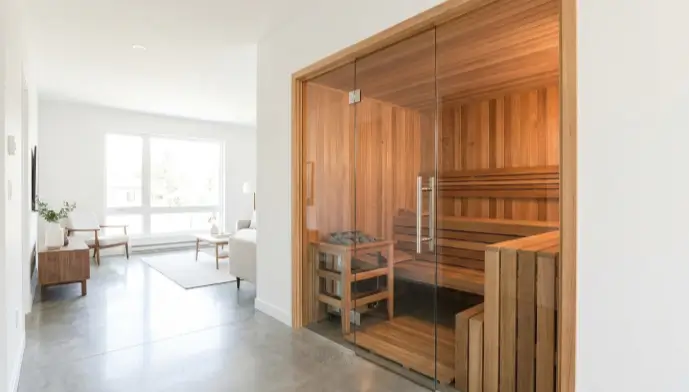
For two people planning daily use, the setup that holds up best is a two to three-person cabin placed inside the house, close enough to a bedroom or bathroom that the walk takes under a minute, with a dedicated exhaust fan for moisture and a heater rated for frequent cycling rather than occasional weekend use. Daily use inside a shared living space rewards planning around ventilation and floor protection as much as around the cabin itself. Here’s what that setup actually looks like, piece by piece.
1. A Location Close to Where You Already Get Ready
Placement inside the house matters more for daily use than almost any other factor. A cabin tucked into a finished basement near a bathroom, or a spare room close to the primary bedroom, gets used far more consistently than one at the far end of a garage or down a cold, unfinished stairwell. The goal is removing every small piece of friction between deciding to use it and actually being in it, since daily habits are fragile and a 90-second walk in a robe beats getting dressed to cross a yard.
2. A Two to Three-Person Footprint That Fits the Room You Have
Interior space is usually the real constraint, not preference. A cabin sized for two to three people, roughly 4 by 5 feet to 5 by 6 feet of interior floor space, fits most spare rooms, finished basement corners, or converted closets without a major renovation. Sizing up for guests sounds appealing, but a larger interior cabin takes longer to heat and eats more of a room you may need for other things, while a properly sized two-person unit heats faster and keeps daily running costs predictable.
3. Floor Protection Sized for Daily Moisture, Not Occasional Use
A sauna used once a week can get by with a simple mat under the door. One used daily needs real floor protection: a waterproof underlayment beneath the cabin base at minimum, and ideally a shallow catch pan or a floor drain if your budget and plumbing access allow it. Daily splashing from a traditional heater, or just daily foot traffic in and out, adds up on a subfloor faster than occasional use does, and retrofitting floor protection after moisture damage shows up costs far more than installing it correctly the first time.
4. A Dedicated Exhaust Fan, Not Just a Passive Vent
Passive ventilation, a simple gap or louvered vent, can keep up with occasional use, but daily humidity output from a traditional heater benefits from an actual exhaust fan ducted to outside air. A small bathroom-style exhaust fan, often $150 to $400 installed, run for 20 to 30 minutes after each session, clears humidity from the room far faster than passive venting alone and protects nearby drywall and framing from the cumulative moisture load of daily use.
5. A Heater Built for Frequent Cycling
Heaters used daily age differently than ones used once a week. A budget heater rated for occasional residential use can wear out faster under a daily schedule, so it’s worth paying a bit more for a unit rated for frequent cycling. For a two-person interior setup, that typically means a 4.5 to 6 kW electric traditional heater or a 1.5 to 2 kW infrared panel system, both sized appropriately for a smaller room without being underpowered for daily heat-up.
6. A Simple, Repeatable Pre-Sauna Routine
Setups that actually get used daily share a common trait: a routine simple enough that skipping it takes more effort than doing it. That might mean towels that live on a hook right by the cabin door, water bottles kept in the room permanently, or a timer both people already have set on their phones. The physical setup matters less here than removing friction, and couples who stop using an expensive interior sauna after a few months usually didn’t buy the wrong cabin, they just never built the small habit around it.
See also: Predictive Analytics in Retail Technology
7. A Basic Hygrometer and an Automatic Shutoff Timer
Daily users benefit from consistency more than extra features. A simple thermometer and hygrometer, often included with the cabin or added for under $30, lets both people repeat a temperature and humidity combination that works without guessing each time. An automatic shutoff timer matters even more for daily use than occasional use, since it’s easy for a session to run long on a night either of you is tired and loses track of time.
8. Buying Based on Room-Specific Specs, Not Lifestyle Photos
When comparing two-person interior cabins for daily use, the numbers that matter are heater wattage, voltage requirement, interior square footage, and warranty length on the heating element, not the lifestyle photography most listings lead with. For questions about matching a specific cabin’s electrical draw and footprint to a real room, the team at SweatDecks lists these specs directly on individual product pages, making it easier to compare a compact infrared cabin against a traditional model on the numbers that actually determine whether it holds up in your specific room under daily use.
9. A Realistic Budget for the Whole Room, Not Just the Cabin
The sauna itself is only one line item once you account for a daily-use setup done properly indoors. A two-person cabin runs $2,200 to $5,500 depending on heater type. Floor protection and a catch pan or drain add $300 to $900. A dedicated exhaust fan with ducting to outside air runs $150 to $400 installed, plus electrician time if the panel needs a new circuit for the heater, another $400 to $1,500 depending on distance from the panel. All told, a daily-use two-person indoor setup often lands between $3,500 and $8,500 once the room itself, not just the cabin, is accounted for. Knowing that number up front avoids the common surprise of a budget that covered the sauna but not the work needed to make it hold up under everyday use.
Frequently Asked Questions
What room in a house works best for a daily-use sauna?
A finished basement corner, spare bedroom, or garage bay near the main living area works best, since a short indoor walk makes daily use far more likely than going outside every session.
Does an indoor sauna need a floor drain for daily use?
It helps but isn’t required. A waterproof underlayment or catch pan handles occasional splashing, while a floor drain speeds up daily cleanup and reduces moisture reaching the subfloor over years.
How do you vent an indoor sauna used every day?
Most daily setups use a small dedicated exhaust fan ducted to outside air, since daily humidity output adds up faster than a passive vent alone can handle.
What size heater holds up best under daily indoor use?
A heater rated for frequent cycling, typically 4.5 to 6 kW electric or 1.5 to 2 kW infrared, holds up better long term than a budget unit built for occasional weekend use.
References
- “Cardiovascular and Other Health Benefits of Sauna Bathing: A Review of the Evidence.” Mayo Clinic Proceedings, 2018. https://pubmed.ncbi.nlm.nih.gov/30077204/
- “Benefits and risks of sauna bathing.” The American Journal of Medicine, 2001. https://pubmed.ncbi.nlm.nih.gov/11165553/
- “Clinical Effects of Regular Dry Sauna Bathing: A Systematic Review.” Evidence-Based Complementary and Alternative Medicine, 2018. https://pubmed.ncbi.nlm.nih.gov/29849692/
By Elena Marchetti