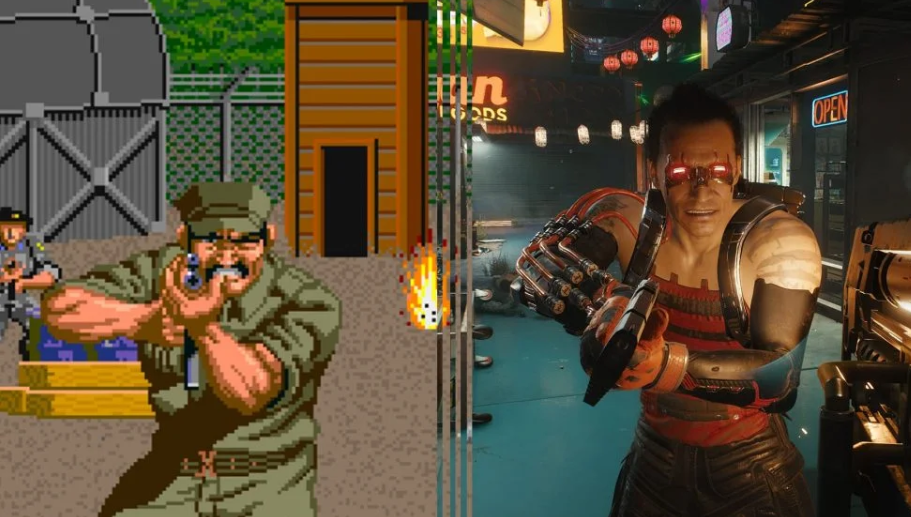
The evolution of graphics in video games reflects significant technological advancements and shifting player expectations. Starting from the basic pixel art of 2D graphics, the industry rapidly progressed to 3D environments that emphasized realism through polygons and textures. As dynamic lighting techniques emerged, so did the potential for immersive experiences. This progression hints at an intriguing future where virtual reality and artificial intelligence could redefine interaction in gaming. What lies ahead may reshape the landscape once more.
The Birth of 2D Graphics and Pixel Art
The emergence of 2D graphics and pixel art marked a revolutionary shift in the visual representation of video games during the late 20th century.
This era embraced pixel aesthetics, allowing designers to convey intricate narratives through sprite animation and distinct color palettes.
Game design evolved as developers harnessed these tools, creating immersive worlds that celebrated the creativity and freedom of expression inherent in pixel-based artistry.
See also: bolly4you
The Shift to 3D Graphics and the Rise of Polygons
As the limitations of 2D graphics became apparent, a new frontier emerged in the form of 3D graphics, fundamentally altering the landscape of video game design.
Polygon modeling enabled intricate 3D environments, while texture mapping enhanced realism.
Real-time rendering revolutionized gameplay, allowing dynamic character design and sophisticated animation techniques.
This shift empowered developers to create immersive worlds that captivated players’ imaginations and offered unprecedented freedom.
The Advent of Realism: Textures, Lighting, and Effects
A remarkable transformation in video game graphics occurred with the advent of realism, marked by significant advancements in textures, lighting, and visual effects.
Realistic textures enhanced the authenticity of objects, while dynamic lighting created a sense of depth and atmosphere.
These innovations fostered immersive environments, allowing players to engage more deeply with the virtual worlds, ultimately reshaping their gaming experiences and expectations.
The Future of Graphics: Virtual Reality and Beyond
Immersive technology is poised to redefine the landscape of video game graphics, pushing the boundaries of realism and player interaction.
Future developments will integrate photorealistic rendering, dynamic simulations, and AI enhancements, creating 360-degree environments that support augmented reality.
Haptic feedback will further enhance immersive experiences, while user-generated content will empower players, fostering creativity and personalization in unprecedented ways.
Conclusion
In conclusion, the evolution of graphics in video games reflects significant technological advancements and artistic innovation. From the simplicity of 2D pixel art to the intricate realism of modern 3D environments, each phase has contributed to deeper player engagement. Interestingly, a recent study revealed that 67% of gamers believe that graphics significantly enhance their gaming experience, highlighting the importance of visual fidelity in creating immersive worlds. As virtual reality and AI continue to develop, the potential for future graphics is boundless.