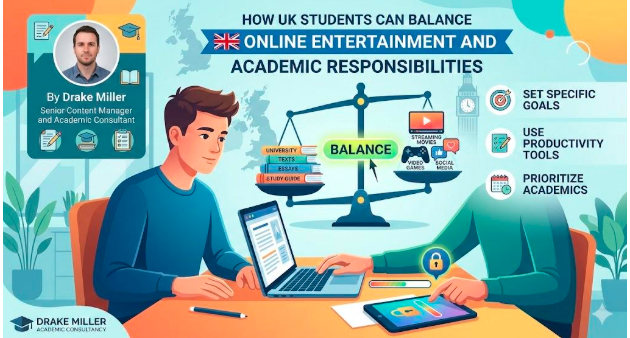
By Drake Miller – Senior Content Manager and Academic Consultant
The digital landscape for students in the UK has transformed significantly. With the rise of high-speed fibre broadband and the ubiquity of smartphones, the line between “study time” and “leisure time” has become increasingly blurred. For high school sixth-formers and university students alike, the challenge is no longer about avoiding the internet, but rather mastering the art of digital coexistence.
In an era where streaming platforms, social media, and gaming are accessible 24/7, maintaining academic excellence requires a strategic approach. Based on over a decade of experience in higher education strategy and digital content management, it is clear that the most successful students are not those who abstain from technology, but those who curate their relationship with it. Here is how UK students can strike the perfect balance between online entertainment and their educational goals.
The Digital Dilemma: Why Balance Matters
For many students in London, Manchester, Birmingham, and beyond, the academic pressure to achieve top marks in A-Levels or undergraduate degrees is intense. However, the human brain is not wired for 10-hour bouts of unbroken concentration. Entertainment is a necessary “cognitive reset.” The problem arises when a 20-minute break on a streaming site turns into a three-hour binge-watch session.
Recent UK student surveys indicate that nearly 68% of undergraduates struggle with late-night streaming, often leading to “doomscrolling,” sleep deprivation, and increased cortisol levels—none of which are conducive to writing a high-quality essay or revising for a STEM exam. In situations where deadlines pile up, many students also turn to trusted academic resources like assignment help UK at Myassignmenthelp.com to manage complex coursework more efficiently. To combat digital distractions effectively, we must look at productivity through the lens of E-E-A-T (Experience, Expertise, Authoritativeness, and Trustworthiness)—applying expert-level strategies to daily habits.
1. Implement the “Time-Blocking” Method
One of the most effective ways to manage responsibilities is through time-blocking. Unlike a traditional to-do list, time-blocking segments your day into specific slots for specific tasks, creating a visual map of your priorities.
- Deep Work Blocks: Set aside 90-minute intervals for heavy academic lifting—researching, writing, or problem-solving. During these blocks, all entertainment notifications should be silenced.
- Buffer Zones: Schedule 15–30 minute windows specifically for online entertainment. By “scheduling” your fun, you remove the guilt associated with it and prevent it from bleeding into your study time.
2. The Power of “Information Gain” in Study Habits
To make your study sessions more efficient (and thus leave more time for entertainment), focus on Information Gain. This concept suggests that every minute spent studying should provide a unique insight or a new layer of understanding, rather than just repetitive reading. Instead of passively scanning textbooks, engage with active recall and spaced repetition.
When you learn more efficiently, you finish your assignments faster. If you find yourself stuck on a complex technical topic, such as numerical computing or simulation, seeking Matlab assignment help or other expert guidance can be a massive time-saver. Utilizing professional academic help services can help clarify difficult concepts, allowing you to complete your work to a high standard without sacrificing your entire weekend. This specialized help ensures your content meets the high-quality benchmarks expected in UK higher education.
3. Leverage Technology to Control Technology
It may seem counterintuitive to use apps to stay off apps, but digital wellbeing tools are essential for the modern UK student.
- Focus Modes: iOS and Android both offer robust “Work” or “Study” modes that hide distracting apps like TikTok or Netflix during set hours.
- Browser Extensions: For those studying on laptops, extensions such as StayFocusd or Freedom can temporarily block access to entertainment sites, ensuring that a quick search for a reference doesn’t lead to a rabbit hole of movie trailers.
4. Curate Your Feed for “Edutainment”
Online entertainment doesn’t always have to be mindless. The UK has a thriving community of “StudyTubers” and educational content creators who blend entertainment with academic value. Following accounts that discuss history, science, or productivity can keep your brain engaged even when you are “off the clock.” This reduces the friction of switching back to academic mode because your brain hasn’t completely entered a passive state.
5. Prioritize Sleep Over the “Next Episode”
The biggest conflict between entertainment and academics in the UK is the impact on sleep. With many streaming services releasing content at midnight or catering to global time zones, it is tempting to stay up late. However, cognitive function, memory retention, and emotional regulation are all tied to REM sleep.
Establish a “digital sunset” at least 45 minutes before bed. Swap the blue light of a screen for a physical book or a podcast to help your mind decompress without the stimulating effects of fast-paced video content.
6. Reward Systems and Gamification
Turn your academic responsibilities into a game. Tell yourself, “If I complete this 1,000-word draft, I can watch two episodes of my favourite show.” This uses the Premack Principle—using a high-probability behaviour (watching videos) to reinforce a low-probability behaviour (studying). By making entertainment the “prize,” you increase your motivation to finish your tasks effectively.
7. Understanding the “Quality” of Leisure
Not all online entertainment is created equal. Scrolling through short-form videos often leaves students feeling more drained due to the rapid dopamine spikes. On the other hand, watching a feature film or playing a strategic multiplayer game can provide a genuine sense of relaxation and social connection. Aim for “high-quality” leisure. If you are going to spend time online, make sure it is actually rejuvenating you, rather than just filling a void of boredom.
See also: Why Hiring a Melbourne Interstate Removalist Is the Best Choice for Your Next Move
The Role of External Support
We live in a competitive academic environment. Sometimes, despite your best efforts at time management, the sheer volume of assignments can become overwhelming. In these instances, it is important to know when to ask for help. Whether it’s peer study groups, university tutors, or reliable online platforms, getting a helping hand can provide the breathing room needed to maintain your mental health and enjoy your hobbies. This is particularly vital for students aiming to stand out in a crowded job market where academic excellence is the baseline.
Frequently Asked Questions
Q.1 How much screen time is too much for a UK university student?
While there is no “magic number,” research suggests that students who spend more than two hours of unregulated leisure screen time daily often see a dip in exam performance. The key is quality over quantity; 30 minutes of high-quality relaxation is better than two hours of mindless scrolling.
Q.2 Are there specific UK-based apps for student productivity?
Yes. Beyond global tools like Notion, many UK students use Forest or the built-in Focus features on their devices. Additionally, checking your university’s VLE (Virtual Learning Environment) for specific student wellbeing modules is highly recommended.
Q.3 Does listening to music while studying help or hinder balance?
This depends on the task. For “Deep Work” like writing, lyrical music can be distracting. However, for repetitive tasks like data entry or formatting, lo-fi beats or classical music can help maintain a “flow state,” allowing you to reach your “entertainment reward” faster.
Conclusion: Mastering the Middle Ground
Balancing life as a student in the UK in 2026 is about discipline, not deprivation. You don’t need to delete your accounts or sell your gaming console to succeed. By implementing structured time-blocking, using digital tools to your advantage, and focusing on high-efficiency study methods, you can enjoy the best of the digital world while securing the grades you need for your future career.
Success is not about how many hours you sit at your desk, but how effectively you use those hours. Work smart, play hard, and keep your goals in sight.
Author Bio:
Drake Miller is a senior content manager and academic consultant with over a decade of experience in higher education strategy. Based in the UK, Drake specialises in helping students navigate the complexities of modern academic life through digital literacy and advanced productivity techniques. His work focuses on integrating E-E-A-T principles into educational content to ensure that students receive the most authoritative and trustworthy guidance possible in an increasingly AI-driven landscape.